
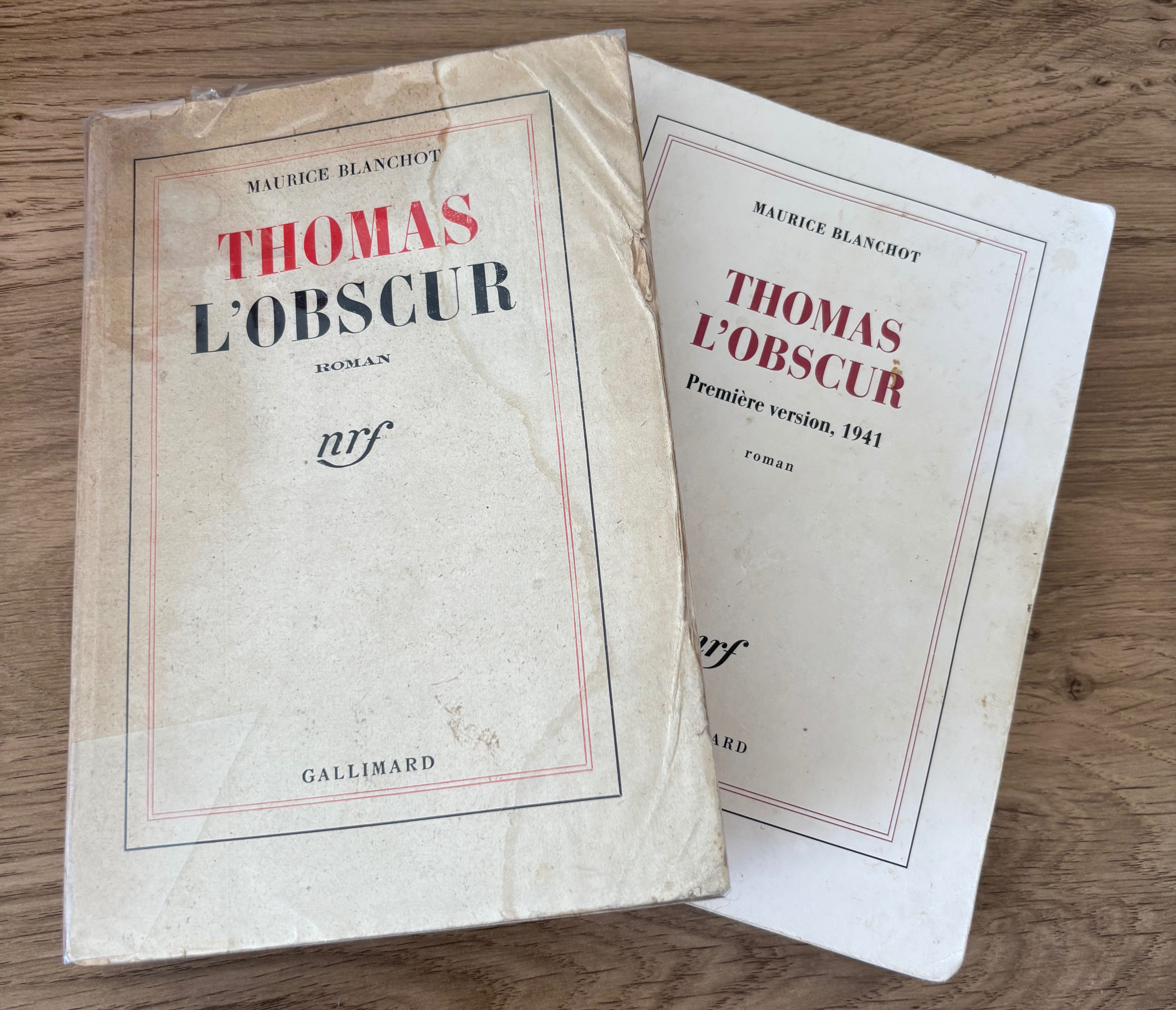
I finished a translation of the first version of Blanchot’s Thomas l’Obscur back in 2019. We had some hiccups with the original publisher, and I kind of forgot about it. I revisited the first half in the summer of 2023, and again, other projects took over. For some reason I found myself thinking about it today, and started reading again. Posting the second chapter below:
He nevertheless decided to turn his back to the sea and went forth into a small forest where he lay down after taking [30] a few steps. The day was about to end; there was almost no more light, and what remained of it seemed to frighten the birds whose cries aroused disagreeable echoes. However, despite the darkness, one could still see certain details of the landscape rather distinctly, in particular the hill that lined the horizon and shone as if the twilight had left it untroubled and free. Unfortunately the trees were also very well lit, and after the impression of freedom came that of a common and painful spectacle whose end one eagerly longs for. The trees no longer seemed like trees, they unravelled themselves in vain in the luminous air; it seemed like the foliage, struck by the sparkling rays, became drab and subjected to the lighting of a sad day. What worried Thomas was that he was laying there in the grass, wishing not to get up for a while, although this position was formally forbidden to him. As the air was already heavy and night was quickly falling, he attempted to put one knee on the ground and, both hands pressed on the earth, stood up halfway. While his other leg swung capriciously, he made another move and despite himself managed to stand fully upright in an attitude both arrogant and indisposed. He was now standing up. In truth there was an indecision in his way of being that cast doubt on what he was doing. Thus, while his eyes were closed, it did not seem that he had renounced seeing in the darkness, it was in fact quite the contrary. Likewise, once he began to walk, he leaned forward with a visible repugnance, and one could think that it was not his legs, but his desire not to walk that made him go forth. He went down into a sort of cellar where darkness was complete. Its disposition immediately seemed inconvenient to an unimaginable point, for wherever [31] he reached with his hands, he abruptly bumped into the wall. This did not prevent him from trying to go forward. Before him, behind him and even above him some very solid masonry barred his path; and this was not the greatest obstacle, he also had to count on his will, his will that was stubbornly resolved to let him sleep there, in an absolute oblivion, in a passivity identical to death. Madness then; however, as if he had nourished an irresistible desire with the contrary of his desire, he felt the need to seek out whether he was still in control of the situation. Normally one should have renounced all hope; but was this an ordinary situation? The manner in which he had entered this site, as obscure as its circumstances were, showed that a certain number of ways of thinking had to be abandoned here, and that he could no longer indifferently consider himself as having or not having a healthy, vigorous, and ultimately real body. In this uncertainty, he felt out the limit of the vaulted pit and, extending his arms, placed his body up against the wall, his body that did not exist as a body, and that in this site offered no more observable features than his mind itself. What dominated him was the feeling of being pushed forward by his refusal to go forward. He was gripped by this thought and concluded that the impassable obstacle of the wall could one day disappear and that he would thus be carried further without knowing how. He should not have been surprised, as much as his anxiety made him distinctly see the future, when a little later he realized that he gained some ground with a few steps. A few steps. This was unbelievable. Truthfully however, his advance was more apparent than real, since this new site was in no way distinguishable from the old, he encountered the same difficulties, it was in a certain manner the same site from which he was distancing himself by the terror of [32] distancing himself from it. Everything seemed to occur in his heart of hearts, it was as if he had stepped onto a path that anguish was opening for him and that existed nowhere but within him, and yet this path was not imaginary, but had the particularity that once one had embarked upon it, one could only go forth with a body made of the most intimate thoughts and desires. Thomas did not immediately understand how things were and made the mistake of casting a glance around him. Manifestly the night was darker and more arduous than he could have expected. Darkness seemed to submerge everything; there was no longer any hope of piercing through its shadows, but one attained its reality in a relationship of overwhelming intimacy. Thomas’ first observation was that he could still make use of his body, in particular his eyes; it was not that he saw anything, but that what he was watching ignored his gaze without allowing him to turn away. This was eventually enough to let him enter into relation with a nocturnal mass which he vaguely perceived as being himself and within which he remained immersed. Naturally he only formulated this remark as a hypothesis, like a convenient supposition to which he attached no credibility. Only the necessity of untangling altogether new circumstances forced him to hold it and even to venture forth towards other, no less risky conclusions. As he had no means of measuring time, hours probably passed before he accepted this manner of seeing, but for himself it was as if fear had immediately carried him away and it was with a feeling of shame that he raised his head to accept the idea he had entertained, to wit that something similar to his own thought could be found outside of himself, while at his heart a miscarried organism had momentarily taken the place of the soul. In any [33] other circumstance, such a reverie would have sharply repulsed him, and even here it was not pleasant to bear. Nonetheless his unease did not come from its lack of likelihood – for, after all, the situation allowed for many eccentricities – but, by means of believing himself to be in contact with his intelligence, which his gaze or hand could touch, he let himself be won over by a feeling of fright over which he could not manage to triumph. The night soon seemed to him gloomier, more terrible than any other night, as if it had truly come out of a wound in thought that could no longer be thought, of thought itself ironically taken as an object by something other than thought. It was the night itself. The images that made its darkness inundated him, and the body that was transformed into a demonic spirit sought to represent them to itself. He saw nothing and, far from being encumbered, made this absence of vision the culminating point of his sight. His eye, useless for seeing, took on extraordinary proportions, was growing in an excessive manner and, stretching over the horizon, let the night penetrate into its centre to create an iris for itself. Through this void, sight and its object became confounded. Not only did this eye that saw nothing apprehend something, it apprehended the cause of its vision. It saw as an object what made it such that it no longer saw. Its own gaze entered into it in the form of an image at the tragic moment when this gaze was considered as the death of every image. New concerns thus arose for Thomas. His solitude no longer seemed as complete as earlier, and he even had the feeling that something real had struck him and sought to slide into him. It was an absurd situation that he could have interpreted in a less fantastical manner. For example, he could easily have believed that his eye had been wounded [34] and that the shame he was feeling prevented him from distinguishing what was happening. But he always had to assume the worst. However, there was some excuse for his gullibility, which was that this impression was so distinct and so painful that it was almost impossible not to yield to it. Even if he had contested the reality of the first phenomenon, he would have had more trouble in not believing something extraordinary, for by all accounts a foreign body had become lodged in his pupil and was endeavouring to go further. It was senseless and horribly disturbing. It was all the more disturbing in that it was not a matter of a small object, but of entire trees, of all the quivering forest, full of life, where he had found himself a few moments ago. He felt this as a weakness that concerned him about the future, like something he was ashamed of and that discredited him. He no longer even paid attention to the details of these events. Perhaps a man slid through the same opening, he could neither have confirmed nor denied it. It also seemed to him that the sea was rising up to him and that the waves managed to penetrate into the type of abyss that he was. But all this barely concerned him. He only noticed his hands that, as if they had found themselves at the heart of his body, sought to recognize the beings that had descended therein and whose nature, albeit generally incomplete, he partially distinguished: a dog having an ear only to subsist, a bird replacing the tree upon which it sang. While serving as organs for Thomas, these beings were given over to acts that escaped all interpretation. Thanks to them, buildings, entire cities were built, real cities made of emptiness and thousands of heaped stones, that were then divided through the action of mathematical thought, leaving behind them only the numbers that were their secret souls. It was [35] upon these ruins that rolled about in blood and occasionally tore through the arteries that other creatures appeared. Without entirely understanding what was happening, Thomas felt that what he had once called passions and ideas were now taking shape within him as particular existences. Fear seized him and was in no way distinguishable from his corpse. Desire was this very corpse that opened its eyes, and, knowing itself to be dead, clumsily returned into the mouth like an animal swallowed alive. These feelings inhabited then devoured him. Every part of his flesh was pressed upon by a thousand hands that were nothing but his hand. A mortal anguish beat against his heart. He knew that around his body his thought, indistinguishable from the night, kept watch. He knew, with a terrible certainty, that it also sought a point through which to enter into him. It fought like the irresistible rising tide. Against his lips, in his mouth, it sought out a monstrous union. Under the eyelids it created a necessary sight. And at the same time it furiously destroyed this face it embraced. Prodigious cities, ruined metropolises disappeared. Stones were cast outside. Trees were transplanted. Hands and corpses were taken away. Only Thomas’ body remained, deprived of sense. And thought, having now returned into him, exchanged contacts with the void.

