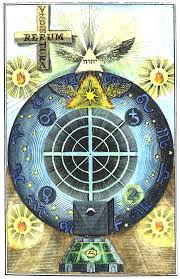
Making good progress on this new book, Ecologies of Emptiness: Cosmic Pessimism and the Kyoto School. I’ve become fascinated with the work of Jacob Boehme, who Nishida Kitarō occasionally invokes. Boehme’s work was also influential on many figures at play in Speculative Realism and Cosmic Pessimism, notably Schelling and Schopenhauer. I’ve been struck by how much his work also resonates with deconstruction, particularly in La Chose, when Derrida writes of deconstruction as an abyssal desire. Derrida doesn’t engage Boehme in there, or a ton elsewhere – but the title of his essay Qual Quelle, ‘anguish, torment, etc.’ and ‘source,’ which mentions Hegel’s reading of Boehme in a footnote, evokes this abyssal desire which lies at the heart of Boehme’s notion of nature. Likewise, although Derrida never himself draws the connection, I think there’s a hidden link between Derrida’s reflections on Ponge and the signature of things in La Chose and Boehme’s Signatura Rerum. Finally, so much could be said about a devourance in Boehme’s nature and what Derrida explores in the two seminar sequels to Politics of Friendship: Eating the Other and Rhetoric of Cannibalism. My main guide to Boehme’s work has been Alexandre Koyré’s La Philosophie de Jacob Boehme (Vrin, 1929); note Paracelsus (another thinker of the Signatura Rerum) on the Gift/Gift interplay at the end.
From Koyré, La Philosophie de Jacob Boehme, pp. 200-203.
[Boehme] wants to express and make us aware of an intuition that he was the only one, or at least the first, to have had in modern times: the intuition of what the Romantics would later call the Nachtseite der Natur. It is the intuition of the demonic character of life; not of the triumphant life which freely blooms and lifts itself towards the light, but of the hidden, obscure life which is a perpetual movement without pause and without goal; of this life that pursues itself, gnaws at itself, devours itself and flees itself; of this life of despair without end and without light; of a life without goal, always destroying itself and always engendering itself anew; a life of unconscious suffering, of an ever-unfulfilled desire, of an atrocious hunger, of misery and hatred, which is das bose Leben, das Hunger-leben, ewiges Sehnen, ewige Flucht, sinnlos und heillos und unerlösbar. Boehme saw this Quaal, this atrocious torment, at the ground of being and life. It is this vision of life that Schopenhauer would put at the heart of his metaphysics, the one he sought deliverance from in the Nothingness of Nirvana, in the complete annihilation and total suppression of life. […]
Such a life, a life without ‘body,’ an eternal hunger which consumes and devours itself, is this not the terrible worm of the Scriptures, this worm that eternally gnaws away at itself, the worm of eternal death? (“And here the eternal Mind has its Original, in that the Will will [go] out of that Source, into another Source of Meekness, and from thence the eternal Source in the Anguish has also its Original, and it is the eternal Worm which generates and eats itself, and in its own Fierceness in itself lives in the Darkness which itself makes; and there also the eternal Infection [or Mixture] has its Original, back from which there is no further to be searched into, for there is nothing deeper, or sooner; the same always makes itself from Eternity, and has no Maker or Creator. And it is not God, but God’s original Fierceness [or Wrath,] an Anxiety [or aching Anguish,] generating in itself, and gnawing [eating or devouring] in it, and yet consuming nothing, neither multiplying nor lessening” The Three Principles XIV, 64) Now, in fact, this worm, this enflamed whirlwind, this wheel of the anguish of the wrathful essences, is indeed Death (Mors). Death, the abyss that is at the ground, at the centre of life. Even more: which is the ground and the centre of life.
Thus life is built upon death: the true death, the one that does not die: which is in no way a simple absence of life: which is something positive: a force opposed to life, which seeks to destroy it, which the latter combats, strives to vanquish, transfigure and transform. However it is in death that life draws its force and its power, and it is in its victory over its death that it finds its supreme joy and its dazzling triumph.
Paracelsus had already said: Im Centro alles Lebens ist Gift. Death, the worm that Boehme finds at the centre of life is, so to speak, an absolute poison. And this poison is the source of life.